Rumba Dance: Timing, Technique and Style Explained

Updated: 6 days ago

What is the Rumba?
Rumba is one of the five core dances in the Latin American genre. Known for its slow tempo, controlled movement, and emphasis on timing, it's often described as the “Dance of Love.”
Although the rumba can appear to be a straightforward dance, it's widely regarded as one of the most demanding and difficult to perfect due to its slow pace, physical engagement and technical complexity.
American Rumba vs British/International Rumba
Rumba exists in two main ballroom styles, each with distinct characteristics.
The American rumba 'box' is danced in 4/4 time using a slow, quick, quick rhythm. The slow step takes two beats, while each quick step takes one beat, so the count is usually 1–2, 3, 4.
For the leader, this means stepping forward on the left foot for counts 1–2, then side on the right foot for count 3, and closing the left foot on count 4. The second half of the box reverses the action, stepping back on the right foot for counts 1–2, side on the left for count 3, and closing the right foot on count 4.
In British, or International, rumba, the basic action begins with a side step, not a forward step. The timing is usually counted 4–1, 2, 3, 4–1, with the side step held through 4–1 before the next weight changes take place on 2 and 3.
This gives the dance its more controlled, suspended quality, because the dancer is not simply stepping through the rhythm evenly. The body continues to work during the held count, creating a slower, more disciplined use of weight, hip action and balance.
This is one reason International rumba often feels more technically demanding than the American rumba box.
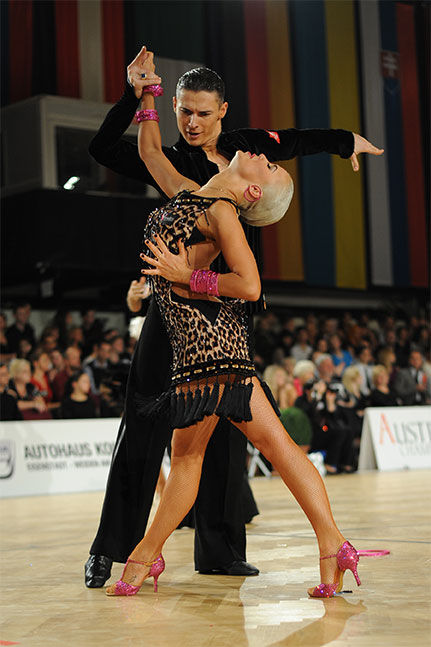
Rumba: Movement and Style
American Style
Based on a box step structure
More compact and contained
Designed for social dancing
British / International Style
Linear movement (forward and back)
Greater use of:
Body stretch
Leg straightening
Controlled weight transfer
American rumba prioritises accessibility and flow, while British rumba focuses on mechanics, control, and visual expression.
Why Rumba is so Technically Demanding
Rumba’s slow tempo increases its level of difficulty.
Timing errors are difficult to conceal
Balance must be held for longer
Weight transfer must be precise
Unlike faster dances, rumba exposes weaknesses rather than concealing them. It's often considered a benchmark for:
Balance and control
Technique
Musical interpretation
Partner connection
In the UK, and in ISTD examinations, the style taught is International rumba. This is the version Edita teaches in her lessons, though the American box is covered here too, particularly for wedding couples because it's easier to learn.
Edita teaches International rumba in private lessons and group classes in a professional dance studio in Paddington, London.
Get in touch to book a lesson.



Comments